By Barth Ikiebe
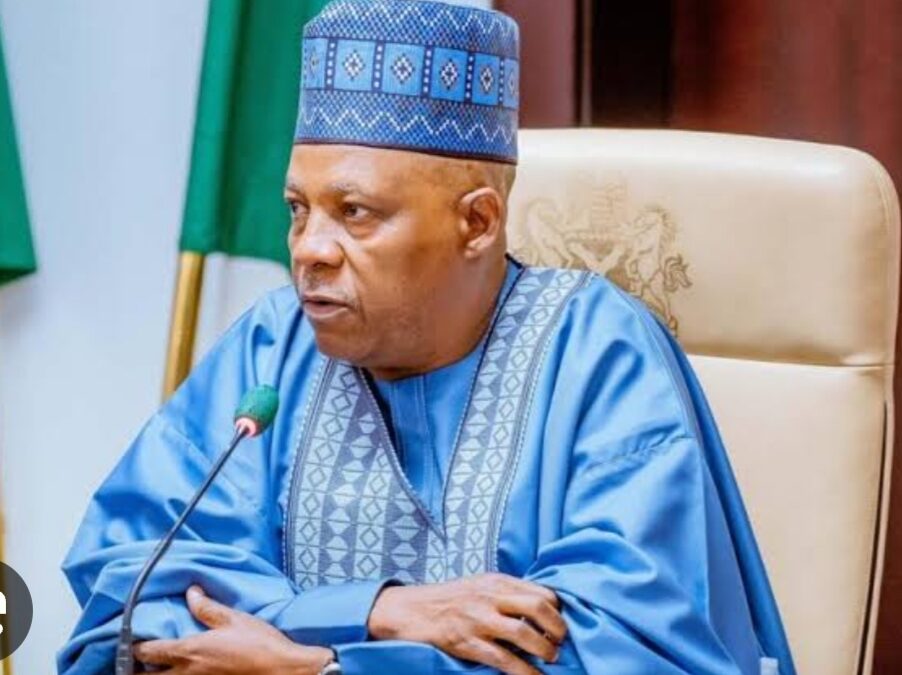
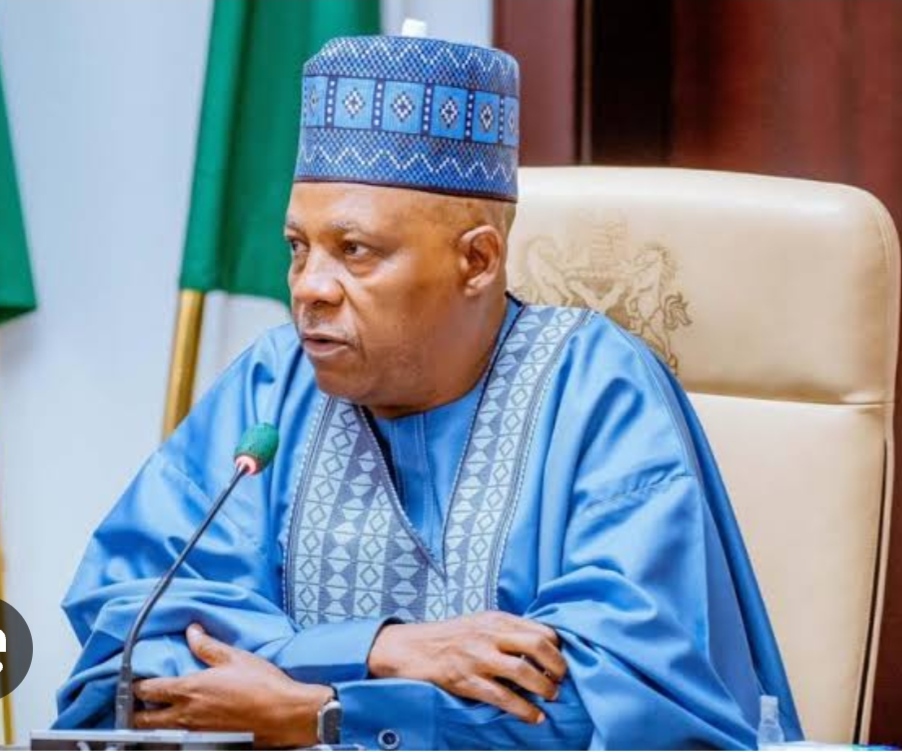
The Vice President, Kashim Shetima, has charged Editors not to focus exclusively on scrutinising the government but to also report developments and progress objectively.
Shetima gave the charge in a video recorded speech while declaring open the 22nd Nigerian Editors Conference on Thursday in Enugu, South East Nigeria.
“As you scrutinise the government, I also urge you to continue telling the full story of our country, including where progress is being made,” he noted.
Shettima said the reforms of the President Bola Ahmed Tinubu administration had required difficult choices but, according to him, were beginning to produce what he described as encouraging economic indicators.
The Vice President urged Nigerian editors and journalists to continue holding the government accountable while also telling the full story of the country, including areas where progress is being recorded.
The Vice President, who is in the United States, where he is leading Nigeria’s delegation to the United Nations General Assembly (UNGA), said the media remained indispensable to Nigeria’s democratic development.
Shettima said the theme was particularly relevant as Nigeria approaches another election cycle, stressing that citizens could only make meaningful choices at the ballot box when they had access to credible information.
He described the media as the Fourth Estate because of its role in interrogating power, informing citizens, shaping public debate and preserving the nation’s institutional memory.
“Your responsibility has become even more demanding in the age of artificial intelligence,
when technology can manufacture convincing falsehoods at unprecedented speed, professional journalism becomes more important, not less,” he stated.
Shettima said the Federal Government’s objective was to ensure that macroeconomic stability translated into jobs, stronger businesses, greater purchasing power and improved quality of life.
He maintained that disagreement between government and the media was natural in a democracy, arguing that such disagreements should be informed by facts and conducted responsibly.
“Government and the media will not always agree, nor should we. Democracy is strengthened when disagreement is informed by facts, exercised responsibly and conducted in good faith.”
He said what should unite the government and the media was the broader Nigerian project.
The Vice President commended the Nigerian Guild of Editors for sustaining ANEC as a platform for dialogue and for choosing a theme focused on the survival and strengthening of democracy.
Earlier, Enugu State Governor, Dr Peter Mbah, challenged Nigerian Editors to go beyond scrutinising those in power and devote greater attention to establishing facts, investigating issues thoroughly and telling the truth, particularly in an era of artificial intelligence and sophisticated disinformation.
While welcoming delegates to the Editors Conference, Dr Mba stated that photographs can be fabricated, voices cloned and videos manipulated to make people appear to say things they never said, while false allegations can spread globally before journalists have the opportunity to establish the facts.
He urged Editors to protect investigative journalism and ensure that rigorous journalism did not become a luxury in Nigerian newsrooms.
“My challenge to you, therefore, is simple – go deeper,” he stated.
Mba said journalists needed the time and curiosity to understand complex issues, while editors should be prepared to protect serious investigative work and ensure that newsrooms distinguished between what generated immediate attention and what the public genuinely needed to know.
The governor stressed that journalism should not be about finding evidence to support a position already taken or becoming an avenue for political grandstanding.
“Its value lies precisely in its independence: examine the evidence, test competing claims, establish what happened, and report what you find,” he advised.
Mbah said the standard should apply equally to the government and its critics, adding that while his administration should be scrutinised where it fell short, progress should also be reported when supported by evidence.
The governor also highlighted the importance of the relationship between government and the media, saying the two institutions did not always have to operate from “opposite sides.”
He said the government had a responsibility to be transparent about what it was doing and accountable for its results, while the press had the responsibility to establish facts and report the truth.
“The obligation for us both is the same in either case – serving the people of Nigeria,” he noted.
Mbah noted that the NGE had chosen Enugu to host its major conference for the second time in two years, describing the decision as a demonstration of confidence in the state.
He described Enugu as a city with a long history of enterprise, cultural life and civic leadership, noting its association with prominent Nigerians including Dr Nnamdi Azikiwe, Professor Eyo Ita, Dr Michael Okpara and Dr Akanu Ibiam.
The governor also used the occasion to highlight developments undertaken by his administration, saying the state was undergoing what he described as one of the fastest and most ambitious transformations in modern Nigeria.
He said the administration’s ambition was to make Enugu an economic gateway to the South-East, one of Nigeria’s top three states by GDP and a national leader in human development and quality of life.
According to him, more than 1,500 kilometres of roads have been constructed or reconstructed, while more than 7,000 classrooms have been delivered.
He also listed the Smart Green Schools and Type-2 Primary Healthcare Centres being established across all 260 wards, restoration of water supply in Enugu metropolis, new transport terminals and CNG buses, the commencement of Enugu Air operations, revival of dormant industries and the development of a new city.
Mbah said the changes were increasingly being felt in the daily lives of residents, including improved access to education and healthcare, better roads and growing interest from businesses and investors.
He acknowledged the support of President Bola Ahmed Tinubu and the Federal Government, particularly increased federal support to states and interventions in roads, aviation, energy and regional development.
He specifically cited the concession of Akanu Ibiam International Airport as an intervention capable of strengthening Enugu’s position as a gateway to the South-East.
The governor expressed appreciation to the President for what he described as the leadership and policy direction of the Federal Government.
Mbah, however, acknowledged that much remained to be done, urging the visiting editors to independently assess the developments in the state.
The keynote Speaker, Emeritus Archbishop of Abuja, John Cardinal Onaiyekan, called for sweeping reforms of Nigeria’s electoral system, including greater independence for the Independent National Electoral Commission (INEC), speedy resolution of election disputes and the introduction of independent candidacy.
He said Nigeria’s democracy could only serve its purpose if governance was centred on the people and the common good.
According to him, although democracy is difficult to practise effectively, Nigerians must continue working towards a system in which leaders are freely chosen by the people and are accountable to them.
Onaiyekan expressed concern that the quality of Nigerian elections appeared to have deteriorated since the return to democratic rule in 1999.
He identified the “do-or-die” attitude of politicians, the influence of incumbency, the deployment of state resources for partisan purposes, questions surrounding INEC’s independence, the conduct of security agencies and prolonged election litigation as major challenges to credible elections.
The Cardinal called for a review of the process for appointing the INEC chairman and Commissioners so that they would not depend solely on the President and state governors, who could themselves be contestants or have political interests in elections.
He also proposed a special election tribunal dedicated exclusively to electoral disputes, with a strict time limit for resolving cases.
According to him, all election cases should ideally be concluded before elected officials are sworn into office.
He further advocated giving ordinary voters the legal right to challenge election results where they believe their votes were improperly counted.
He said the current arrangement, under which mainly candidates have the legal standing to challenge election results, did not sufficiently recognise the rights of citizens whose votes were at stake.
The Cardinal also called for the introduction of independent candidates, particularly at the local government level, saying citizens should be able to support credible individuals outside the existing political party structure.
He described the dominance of political parties and their “godfathers” as a concern that needed to be addressed through electoral reform.
In the presidential election, Onaiyekan proposed a two-round system requiring a candidate to secure at least 50 per cent of votes cast to win.
He said where no candidate attained the threshold, the two leading candidates should participate in a second round to determine the winner.
The Cardinal also advocated stricter rules against legislators changing political parties after being elected on another party’s platform.
He proposed that any legislator who crossed to another party should return to the constituency to seek a fresh mandate under the new party.
He said the seven proposals he outlined should be considered by the National Assembly that would emerge from the 2027 elections.
On the 2027 elections, Onaiyekan said there was limited time to fundamentally alter the existing electoral framework and urged stakeholders to work with the current laws to ensure free, fair and credible polls.
He said the quality of elections ultimately depended not only on laws but also on the sincerity with which political actors and institutions implemented them.
Turning to the role of the media, Onaiyekan described the press as a critical institution for sustaining democracy and holding the government accountable.
He urged media organisations to report government policies and actions critically where necessary while maintaining professional independence from political and financial interests.
He called for professional autonomy, urging media organisations to resist pressure from government, private organisations and corporate interests that fund them.
According to him, a free press is indispensable to genuine democracy, noting that Nigeria has a diverse media landscape comprising newspapers, radio, television and social media.
He, however, warned that the rapid development of artificial intelligence had introduced new opportunities as well as dangers into the communication space.
Onaiyekan urged the media to use its relative freedom responsibly and professionally to strengthen democratic governance.
“The relatively good margin of freedom, which the Nigerian Media now enjoys, should be used with responsibility and professionalism, to rescue democracy in our nation, to uphold and to nurture it for a great nation under God,” he said.
He also linked the emergence of AI to wider questions about human dignity and responsibility, citing Pope Leo XIV’s 2026 encyclical Magnifica Humanitas, which addresses safeguarding the human person in the age of artificial intelligence. The Vatican describes the encyclical as focusing on the human person, truth, work, freedom and the common good amid the rise of AI.
The Cardinal further urged religious leaders to contribute more actively to the promotion of good governance rather than seeking political patronage.
He said Christian and Muslim leaders should use their platforms to preach honesty, accountability, respect for law and concern for the common good.
“Power belongs to the people. By that, we mean that it does not belong to the political leaders and office holders, and those entrusted with political power must exercise it with a sense of responsibility before God”.
Onaiyekan said Nigerians should remain patient as they build democratic institutions but should not abandon the pursuit of a government “of the people, by the people, for the people.”
The Chairman of the occasion, the Obi of Onitsha, Igwe Nnaemeka Alfred Achebe, charged Nigerian editors to remain steadfast in defending democracy and protecting citizens from misinformation and disinformation, particularly as artificial intelligence makes false information increasingly difficult to detect.
The monarch said democracy should not be regarded as a system that, once established, would automatically sustain itself, stressing that it requires constant protection and nurturing.
“Democracy is not a monument we erect and then walk away from. It is more like a fire lit to keep the house warm. It must be tended, fed, protected from wind and rain, or it dies quietly in the night while everyone believes it still burns,” he said.
Achebe, who traced Nigeria’s political journey from independence through military rule to the current democratic era, said the media had a crucial responsibility in ensuring that citizens were adequately informed to make meaningful choices at the ballot box.
According to him, the ballot represents the voice of the citizen, while the media serves as the mirror through which citizens understand the world around them.
“When the mirror is cracked, or worse, deliberately distorted, the citizen no longer votes from truth but votes from illusion. And a democracy built on illusion is not genuine democracy but drama.
The traditional ruler said the emergence of artificial intelligence had created a new and potentially dangerous dimension to electoral disinformation, as falsehoods could now be produced with unprecedented speed and sophistication.
He noted that technology could be used to create fake audio recordings, videos and images capable of making public figures appear to say or do things that never happened.
Achebe cited the possibility of fabricated audio in which a governor appeared to make a statement he never made, videos showing candidates in places they had never visited and fake images of violence designed to inflame public sentiment shortly before elections.
The Obi of Onitsha warned that the threat was no longer hypothetical, noting that AI-generated misinformation was already capable of spreading through social media platforms and private messaging groups.
He said Nigeria’s strong community and family networks, which ordinarily served as sources of social cohesion, could also become channels for the rapid spread of false information because people tended to trust information received from friends, relatives and community members.
Achebe urged journalists to prioritise verification over speed, saying the traditional premium placed on being first with the news must give way to a stronger commitment to accuracy in an era when false information could be generated and distributed instantly.
He also urged editors to deepen their understanding of AI and other tools used to manufacture disinformation, including recognising signs of synthetic voices, manipulated images and coordinated networks of accounts spreading false narratives.
Beyond detecting falsehoods, he said the media must educate citizens to develop the ability to question and verify information without becoming cynical.
“A citizenry that believes everything is as dangerous as one that believes nothing at all,” he warned.
Achebe also identified courage as a critical responsibility of journalists, urging editors to expose falsehoods irrespective of which political party or interest group benefits from them.
He said journalistic integrity in the era of AI-generated disinformation required the media to correct falsehoods “regardless of who benefits from them,” before, during and after elections.
The monarch acknowledged the difficult environment in which Nigerian journalists operate, including economic pressures, political intimidation and the speed at which information now circulates.
He, however, expressed confidence in the capacity of the Nigerian media to rise to the new challenge, recalling its historic role in exposing injustice, supporting the struggle for independence and documenting the country’s major political developments.
Achebe urged the editors to make the Enugu conference more than an occasion for speeches and communiqués, but a platform for renewed commitment to defending truth and democracy.
He further charged the editors to remain steadfast even when politicians, electoral institutions and other democratic actors failed in their responsibilities.
The Obi of Onitsha offered royal blessings to the editors and prayed for their safety and good health.
The conference with its theme, “The Ballot, the Media and the Task of Keeping Democracy Alive,” with a sub-theme, “When Lies Look Real: Detecting and Debunking AI Disinformation Before, During and After Elections”, continues on Friday.