On The Frontline With Boma
Politics, it is often said, has no permanent friends or enemies, but permanent interests. It is a game in which yesterday’s adversaries can become today’s allies, and those who once stood on opposite sides of the political divide can suddenly discover common grounds when circumstances demand it. Perhaps this is one of the most enduring lessons from President Bola Ahmed Tinubu’s visit to Rivers State on Saturday, November 7, 2026. It was a visit that carried several political meanings, stirred different emotions and, more importantly, raised expectations among the people of a state whose political and economic contributions to the Nigerian federation cannot be overlooked.
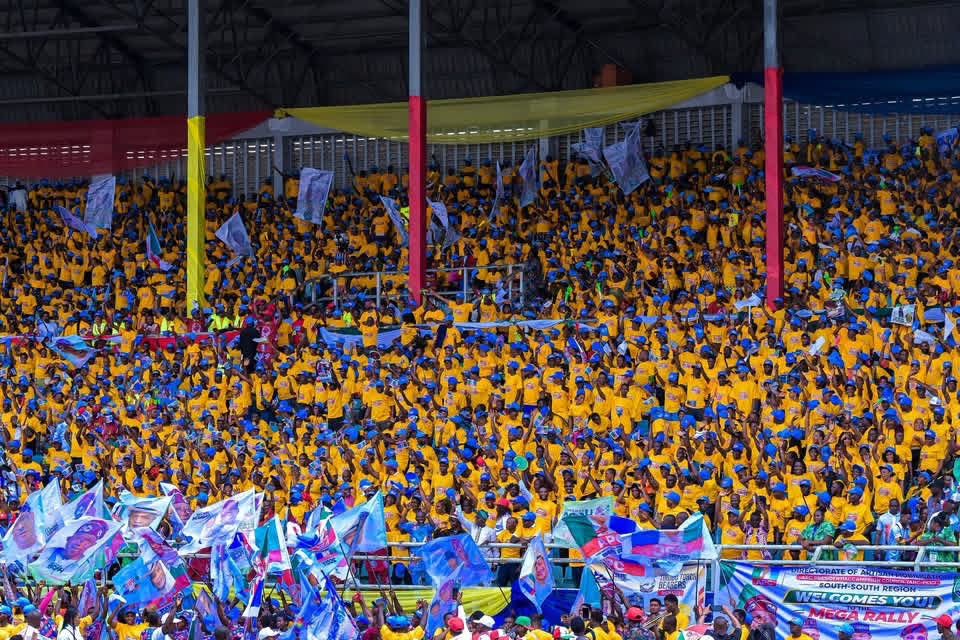
President Tinubu arrived in Rivers State for the presidential campaign rally organised by the Rainbow Coalition at the 40,000-capacity Adokiye Amiesimaka Stadium, Port Harcourt. Accompanied by his wife, Senator Oluremi Tinubu, Vice President Kashim Shettima and an impressive retinue of political heavyweights, the President was received by Governor Siminalayi Fubara, the Minister of the Federal Capital Territory and former Rivers State Governor, Nyesom Wike, and other prominent political leaders. The atmosphere was electric, the political enthusiasm palpable, and the crowd, drawn from the 23 local government areas of the state, was determined to make a statement.
Unfortunately, circumstances beyond my control prevented me from attending the rally physically. However, I had a correspondent who left his residence as early as 7:30 a.m., hoping to beat the notorious traffic that often accompanies major public events in Port Harcourt. Even he could not escape the congestion occasioned by the movement of party supporters and vehicles conveying people from different parts of the state to the stadium. He eventually arrived at about 8:45 a.m.
By 9 a.m., the stadium was already set for the august visitors. The band was ready, the entertainment was in full swing, and supporters occupied their designated sections in colourful displays of party loyalty. They waited, and waited, but the visitor, who was then in neighbouring Akwa Ibom State, had yet to arrive. The scorching weather appeared not to matter. Neither did the long hours of waiting diminish the enthusiasm of those who had come to demonstrate their support. Their message was unmistakable: “Tinubu is our president, no be cho cho cho!”
When I became strong enough, I settled into my sofa to watch the proceedings. My first stop was ARISE News, but the station was transmitting another live programme. I switched to Channels Television and, fortunately, the rally was being broadcast. I remained glued to the screen, determined to see the beginning and the end of what was expected to be a defining political outing.
I watched the masters of ceremonies take their turns, the singers entertain the audience, and dancers display their skills. The music continued, the performances were seemingly endless, and the atmosphere, at some point, reminded me more of a carnival or cultural festival than a political gathering. Supporters gathered around the podium as the entertainment continued. Eventually, the President arrived at about 1 p.m., bringing the long wait to an end.
But while the music and political excitement were entertaining, my expectations were considerably higher. I was not merely interested in the spectacle of a presidential visit. I wanted to hear what the President had brought to Rivers State beyond the familiar political assurances of loyalty and electoral support. I wanted to hear about the future of a state that has contributed immensely to the economic survival of this country and whose votes, in the 2023 presidential election, played a significant role in his emergence as President.
It is important to acknowledge that Rivers State did not stand aloof when the President needed electoral support. The votes from the state strengthened his electoral fortunes, and President Tinubu himself acknowledged the contribution of Rivers people. Indeed, he recalled how their support came at a critical moment when his political fortunes appeared uncertain. That acknowledgement was welcome. However, gratitude, particularly from the highest office in the land, should not end with words. It should translate into deliberate policies, projects, appointments and opportunities that improve the lives of the people.
The speeches preceding the President’s address were largely centred on political loyalty and the promise of votes. Governor Fubara assured him that Rivers State would deliver three million votes and personally committed himself to ensuring that the promise was fulfilled. The FCT Minister, Nyesom Wike, equally reaffirmed his political commitment to the President, insisting that Rivers people had already made up their minds. Both men appeared united in their resolve to deliver the state to the President.
When President Tinubu eventually mounted the podium, he recalled the political crisis in Rivers State that necessitated his intervention, including the emergency rule that was imposed during the height of the disagreement between the governor and his predecessor. He commended Governor Fubara for what he described as maturity, understanding and respect for the intervention of elders. He also acknowledged Wike as a partner in progress.
And that, essentially, was the political story of the day: reconciliation, loyalty and the quest for electoral support.
To be fair, the reconciliation between Governor Fubara and Wike is perhaps one of the most significant developments to emerge from the visit. Rivers State has paid dearly for the political hostilities that threatened its stability, disrupted governance and created uncertainty about the direction of the state. The political disagreement was not simply a disagreement between two individuals. Its consequences were felt by civil servants, contractors, businesses, political appointees and ordinary residents whose daily lives were affected by the tension.
Therefore, any genuine reconciliation that restores peace, stability and responsible governance deserves commendation. We cannot continue to celebrate political supremacy at the expense of development. A state cannot make meaningful progress when its political leaders are perpetually engaged in a battle of supremacy. The people deserve better.
However, the question remains: is this reconciliation founded on genuine forgiveness, mutual respect and a shared commitment to the development of Rivers State, or is it a convenient political arrangement fashioned around the next electoral contest? Time will tell. The real test will not be the smiles, handshakes and public declarations witnessed at the stadium, but the ability of the political actors to sustain the peace when the excitement of the campaign has subsided.
This brings me to the bitter pill of the visit. I expected the President to use the opportunity to address some of the pressing economic and developmental concerns of Rivers people. I expected to hear something substantial about the proposed Bonny Deep Sea Port, a project with enormous potential to transform the maritime economy, create employment and reposition Rivers State as a major investment destination. The Federal Government’s reported approvals and regulatory groundwork for the project should be followed by concrete steps towards implementation. A project of such magnitude should not remain an item of political conversation while its economic possibilities remain untapped.
I expected some reassuring words about the development of the Onne and Rivers ports, the completion and maintenance of critical federal roads, and the wider infrastructure needs of the state. The Bonny-Bodo Road and the Federal University of Environment in Ogoniland are important federal interventions, but the state deserves a broader and sustained development agenda. The strategic importance of Rivers State to Nigeria’s oil and gas industry, maritime activities and national revenue generation should command corresponding federal attention.
I also expected the President to address the need for more inclusive representation of Rivers people in strategic federal appointments. It is not enough to count political appointments as evidence of goodwill. What matters is whether the people have meaningful representation in decision-making positions where policies affecting their lives and economic future are formulated. Rivers has competent men and women who can contribute to national development. They should not be remembered only during electioneering campaigns.
Then comes the economic reality confronting ordinary Nigerians. Inflation, the rising cost of food, transportation, electricity and other essential commodities have continued to stretch household incomes. Poverty is not a political slogan; it is a daily experience for families struggling to provide basic necessities. I expected the President to speak directly to these concerns and offer a reassuring picture of how his administration intends to ease the burden. When a President stands before a mammoth crowd, particularly one drawn from a state that has made substantial contributions to the national economy, there is an opportunity to communicate not only political intentions but also a clear vision of economic relief.
Interestingly, the President had visited neighbouring Akwa Ibom State before arriving in Rivers. There, he commissioned several projects executed by the state government. That contrast was difficult to ignore. While Akwa Ibom presented completed projects for presidential commissioning, Rivers received a political rally. There is nothing wrong with campaigning, but should the people of Rivers not also have expected a substantive development announcement or a federal commitment that would give the visit a lasting significance beyond its political purpose?
The people who waited under the scorching sun, travelled from distant local government areas and endured hours of traffic were not merely an audience for political entertainment. They were citizens with expectations. Many were ordinary people who may never have the opportunity to see the President again, much less speak directly to him. Their presence should have been an opportunity to reassure them that government understands their difficulties and is prepared to respond.
Yet, I do not wish to dismiss the unseen dividends of the visit. Beyond the immediate political calculations, the renewed relationship between Fubara and Wike, if sustained, could restore confidence in governance, encourage investment and create an atmosphere in which development can thrive. Political stability is itself an economic asset. Investors are more comfortable in an environment where government functions without unnecessary disruptions and where public institutions are allowed to operate.
But peace must not become a political commodity exchanged for electoral loyalty. It must be a commitment to the people and their collective wellbeing. Governor Fubara must be allowed to govern effectively, while the former governor and other political stakeholders must recognise that the mandate belongs to the people and that the overriding responsibility of every leader is to serve them.
There is also a lesson for the electorate. The Permanent Voter Card is not merely a ticket to political rallies or a tool for endorsing the ambitions of politicians. It is an instrument of accountability. The President himself reminded supporters that their PVC was their weapon against poverty. That is a powerful message, but it must also apply to the performance of those seeking public office. Votes should be earned through demonstrable achievements, credible programmes and a willingness to listen to the people, not simply through political endorsements and promises of millions of votes.
As I watched the proceedings from my television screen, I could not help reflecting on the enormous expectations that accompanied the President’s visit. I wanted to hear something that would make the ordinary Rivers man and woman say that, indeed, the President had come, seen their challenges and left a commitment that would change their circumstances. Instead, much of what dominated the occasion was political reconciliation and the assurance of electoral victory.
Let us be clear: we welcome President Tinubu to Rivers State. We welcome peace among our political leaders. We welcome every genuine effort to move the state forward. But we must also insist that the relationship between Rivers State and the Federal Government should be built on more than political convenience. It should be a partnership founded on fairness, equity, development and mutual respect.
Rivers State has given Nigeria much. It has given the President electoral support. It has given the nation its oil wealth, maritime resources and strategic economic advantages. It is only fair that the state receives commensurate attention in federal development planning.
The unseen dividends of the visit may yet emerge through a more stable political environment and improved cooperation among our leaders. But the bitter pill is that the ordinary people are still waiting for tangible dividends that go beyond the excitement of a campaign rally.
Peace is good. Reconciliation is welcome. Political loyalty has its place. But development must be the ultimate destination. We are for peace and prosperity in Rivers State. Anything short of these is no deal and remains unacceptable.
On the Frontline, truth is power; it is the strength of the pen. It is the shield of the weak and the defenceless.