
On The Frontline With Boma

Words matter. They can heal wounds, inspire hope, calm tensions and unite a people. But words can also divide, inflame passions, deepen distrust and expose the true state of a nation. History is replete with examples of powerful men whose careless utterances eventually became symbols of political arrogance and democratic decline.
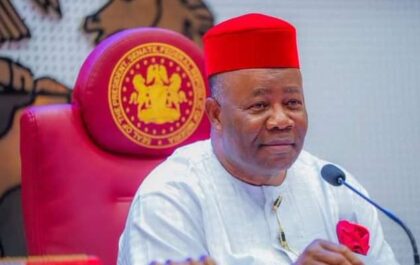
Last Thursday, June 18, 2026, Nigerians heard a statement that has continued to generate discussions within political circles, homes, markets, campuses and social media platforms. Representing President Bola Tinubu at the commissioning of a road project in Abuja, Senate President Godswill Akpabio declared on live television that President Tinubu would continue to remain President of Nigeria “whether people like it or not.”
The statement landed like a thunderbolt.
Many Nigerians watched in disbelief. Others dismissed it as political excitement. Some considered it an innocent expression of loyalty. Yet for millions of citizens struggling under economic hardship, insecurity and uncertainty, the remark sounded far more troubling.
Whether people like it or not?
The immediate question is: who are the people being referred to? Opposition politicians? Critics of government? Those who disagree with current policies? The unemployed graduate? The market woman struggling with inflation? The pensioner whose savings have become worthless? The farmer afraid to go to the farm because of insecurity?
Democracy thrives on consent. Governments derive legitimacy from the people. Elections are contests of ideas and choices. Citizens reserve the right to support or reject leaders through the ballot. Therefore, any statement that appears to suggest inevitability before an election naturally raises concerns.
As I listened to Senator Akpabio, I found myself wondering why a man occupying one of the highest offices in the land would make such a remark. Lawmakers at that level undergo orientation on legislative ethics, public communication and protocols. They understand the weight of words and the implications of public pronouncements.
Perhaps political excitement overtook caution.Perhaps loyalty overshadowed discretion.Or perhaps the statement reflects a growing political culture where power increasingly speaks with certainty rather than humility.
Godswill Akpabio is certainly not a political novice. He has traversed virtually every major corridor of power. He served as commissioner in Akwa Ibom State, became governor and secured re-election. He moved to the Senate, rose to become Minority Leader, later served as Minister of Niger Delta Affairs, contested the presidential primary of his party and eventually returned to the Senate where he emerged Senate President.
His political journey has been remarkable.
Precisely because of this experience, many Nigerians expected greater restraint.
Experience ordinarily teaches caution. It teaches the importance of measured language, especially in fragile democracies where political statements can either strengthen public confidence or deepen existing fears.
Under Akpabio’s leadership, the Senate has not escaped controversy. Allegations and accusations have repeatedly tricked into the public space. More importantly, many citizens have increasingly viewed the National Assembly as being too comfortable with the executive arm of government.
This is not to suggest that confrontation should define relations between the executive and legislature. Democracy requires cooperation among the arms of government. However, cooperation must not destroy oversight. Harmony should not eliminate accountability.
The doctrine of separation of powers exists precisely to prevent excessive concentration of authority.
When citizens begin to perceive their parliament as an extension of the presidency, confidence in democratic institutions weakens. The legislature must not only be independent; it must also be seen to be independent.
Today, many Nigerians complain that the National Assembly appears more eager to defend the executive than to question government policies that impose hardship on citizens.
Fuel subsidy removal has increased transportation costs. Food prices continue to rise. Electricity tariffs have generated complaints. The value of the naira has fluctuated dramatically. Small businesses are struggling. Youth unemployment remains alarming. Insecurity persists in many parts of the country.These realities have produced frustration among citizens.
Against this backdrop, the statement “whether you like it or not” inevitably sounds insensitive.
The ordinary Nigerian wants reassurance, not intimidation.The citizen wants hope, not inevitability.The voter wants to believe that his ballot will count.
One of democracy’s greatest strengths is uncertainty. No election result should be presumed before the people speak. Every election cycle provides citizens with an opportunity to evaluate leaders and decide whether to renew their mandate.
When political actors speak as though outcomes are predetermined, suspicions naturally arise.
Has the 2027 election already been concluded?
Have voters become irrelevant?
Will the electoral process merely ratify predetermined outcomes?
These questions may appear uncomfortable, but public statements often create public interpretations.
Perhaps Senator Akpabio intended none of these meanings. Perhaps he merely sought to express confidence in President Tinubu’s re-election prospects. Political endorsements are not unusual. Parties routinely express optimism about future victories.
However, leaders must appreciate that words spoken from elevated offices carry extraordinary weight.
A village politician may speak carelessly.A Senate President cannot afford such luxury.His office symbolizes one of the pillars of Nigerian democracy. His words therefore become national statements.
What message does such rhetoric send to young Nigerians already skeptical about politics? What impression does it create among first-time voters? How does it affect citizens who increasingly believe that their votes do not matter?
Democracy survives not merely through institutions but through public confidence.
Once people lose faith in elections, the entire democratic structure becomes vulnerable.
This is why political leaders must choose language carefully. They must avoid statements capable of undermining confidence in the electoral process.
Even supporters of President Tinubu should be concerned. Every president benefits when citizens believe his mandate emerged through genuine competition and popular support.
Victory obtained through persuasion carries legitimacy.Victory perceived as inevitable breeds suspicion.
Nigeria’s democratic journey has not been easy. The nation endured military rule, political instability and years of authoritarian governance. Many citizens sacrificed greatly for democratic freedoms. Some paid with their liberty. Others paid with their lives.
Therefore, any statement that appears to diminish the importance of electoral choice understandably generates anxiety.
The Senate President owes Nigerians clarification.
Was the statement merely political rhetoric?
Was it an expression of confidence?
Or was it something more troubling?
At a time when many citizens already feel alienated from government, leaders should build bridges rather than deepen divisions. Public officials must understand that authority is temporary and that power ultimately belongs to the people.
For crying out loud, public events are not platforms for issuing what many perceive as threats against critics or political opponents. Those elected to represent the people must demonstrate restraint, humility and respect for democratic principles.
The suffering in the land is real.
The anger is real.
The frustrations are real.
Many Nigerians endure silently. Parents struggle to feed their families. Graduates search endlessly for jobs. Small business owners fight to survive. Communities continue to mourn victims of insecurity.
These citizens deserve empathy.They deserve reassurance.They deserve leaders whose words comfort rather than provoke.
As the nation moves gradually toward another election season, politicians would do well to remember that democracy belongs to the people. No office holder, no matter how powerful, can permanently substitute the will of the electorate.
In the end, Nigerians will decide.
Not threats.
Not assumptions.
Not political declarations.
The ballot remains the voice of the people.
And perhaps the greatest lesson from this controversy is that leaders must never speak in ways that make citizens feel irrelevant in their own democracy. For once the people begin to believe that their choices no longer matter, democracy itself becomes endangered.
Whether Nigerians like a government or not remains their constitutional right.
Whether they renew a mandate or withdraw it remains their democratic power.
And whether leaders remain in office or return home should always be determined, not by declarations from political podiums, but by the sacred verdict of the ballot box.
That is democracy.
Anything less is a dangerous journey.
On The Frontline With Boma is published by The Port Harcourt Telegraph Newspaper authored by the managing editor
AKPABIO's ' WHETHER YOU LIKE IT OR NOT: A THREAT OR SLAP ON THE MASSES ?