

On the Frontline With Boma
There are speeches that leave audiences inspired, speeches that leave audiences informed, and speeches that leave audiences exhausted. Unfortunately, Nigeria is increasingly witnessing the last category. The recent Convocation Lecture delivered by Nyesom Wike at the University of Port Harcourt offers an opportunity to reflect on what such academic platforms are meant to achieve and what they should never become.
There is an old saying that even the sweetest song can become irritating when sung for too long. That wisdom came flooding back on June 6, 2026, as Nigerians sat before their television screens and mobile devices watching what was expected to be a thought-provoking convocation lecture but gradually transformed into an endurance test.
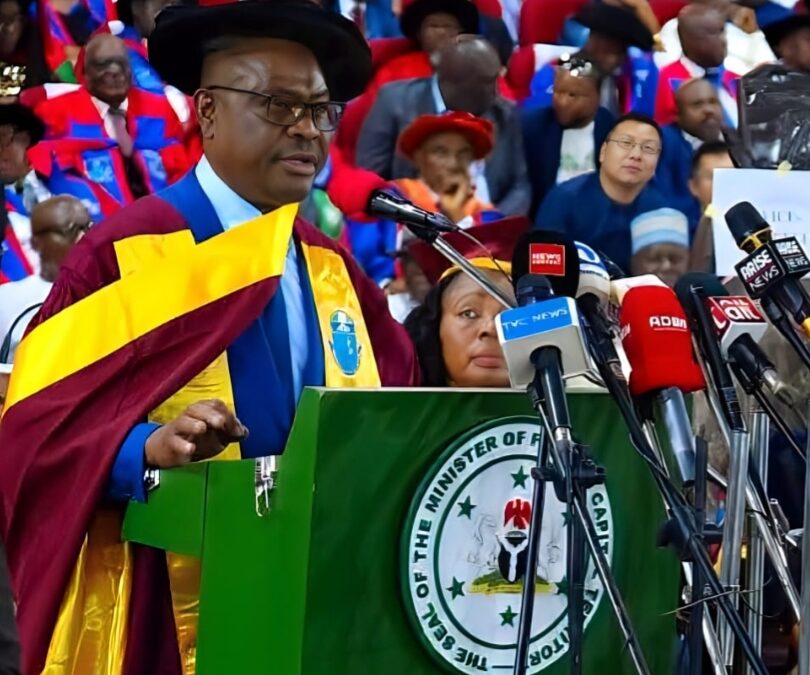
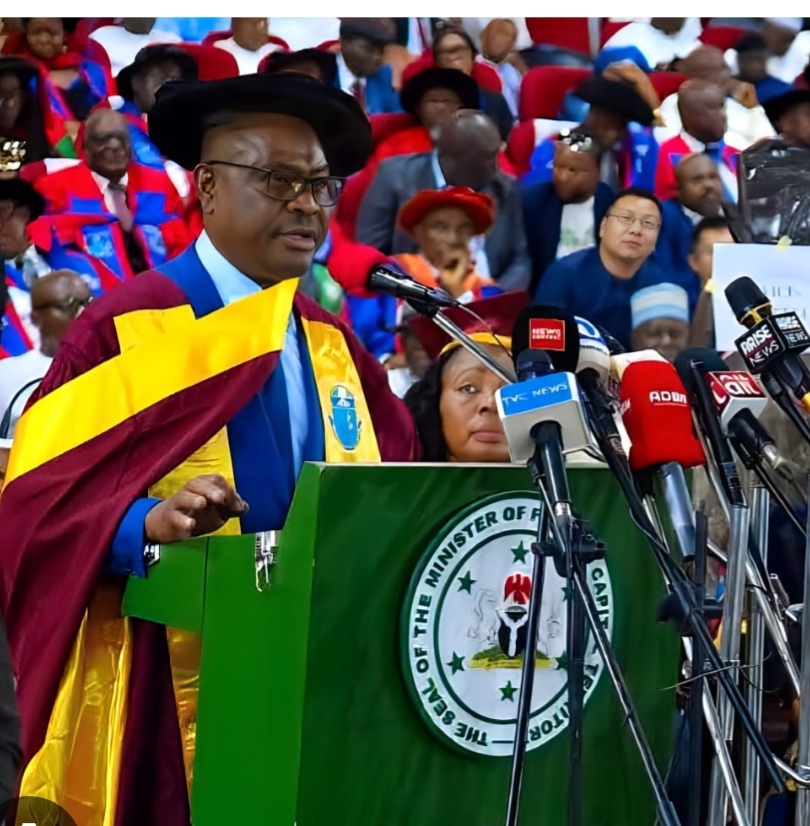
On that day, the Minister of the Federal Capital Territory, Nyesom Wike, delivered the Convocation Lecture at the 36th Convocation Ceremony of the University of Port Harcourt. The event attracted widespread attention. Major national media platforms hooked into the broadcast as political observers, academics, students and ordinary Nigerians tuned in to listen to a lecture titled Leadership and Infrastructure Development in Nigeria: Lessons for Future Leaders.
The topic itself was compelling.
Leadership remains one of Nigeria’s greatest challenges, while infrastructure development continues to define the success or failure of governments at all levels. Combined, the subject promised a rich conversation on governance, development and nation-building. For anyone interested in public affairs, it was difficult to look away.
Wike himself is not a stranger to public speaking. Whether one agrees with his politics or not, he is a politician who understands the power of communication. He is perhaps one of the most media-conscious political figures in contemporary Nigeria. He believes in the effectiveness of live broadcasts and seldom misses opportunities to engage the public through the media.
At the beginning, the lecture flowed reasonably well.
The minister read with confidence and appeared comfortable with the material before him. The audience listened attentively. The cameras panned across the hall and everything seemed in order.
But then the lecture continued.
And continued.
And continued.
What began as an interesting discourse gradually became a marathon.
I listened attentively for over forty-five minutes, expecting that the lecture was approaching its conclusion. It was not. I left briefly for the kitchen to prepare something to eat. The exercise took more than thirty minutes. Because my kitchen is close to the sitting room, I occasionally glanced at the television to see whether the lecture had entered another segment of the programme.
To my surprise, the lecture was still going on.
The same speech.
The same reading.
The same seemingly endless journey through pages upon pages of prepared text.
When I returned to the sitting room, the lecture remained in progress. Even more revealing were the reactions of some people in attendance. Television cameras inadvertently captured what many viewers at home were already experiencing. Some faces wore expressions of exhaustion. Others appeared frustrated. A few dignitaries seemed unable to hide their boredom. Some were reportedly seen struggling to stay awake among the VIP guests.
At that point, one question came to mind:
What manner of convocation lecture was this?
The purpose of a convocation lecture is not merely to speak. It is to communicate. There is a difference.
Communication is measured not by how much a speaker says but by how much the audience retains. A speech may contain thousands of words, yet communicate very little if the audience loses interest halfway through.
One of the greatest mistakes public speakers make is assuming that quantity equals quality.
It does not.
The world’s most memorable speeches are often remembered because they were concise, powerful and impactful.
Abraham Lincoln’s Gettysburg Address contained fewer than 300 words.
Martin Luther King Jr.’s iconic “I Have a Dream” speech lasted less than twenty minutes.
History repeatedly teaches us that great ideas do not require endless hours of delivery.
Even in academia, where intellectual depth is highly valued, brevity remains a virtue.
A convocation lecture is not a doctoral dissertation.
It is not a government white paper.
It is not a legal brief.
It is a ceremonial intellectual address intended to inspire, educate and challenge minds.
The best convocation lectures are intellectually rich yet accessible. They communicate complex ideas in simple language. They leave audiences thinking, not sleeping.
This is why many universities across the world pay close attention not only to who delivers a lecture but also to how it is delivered.
A good lecture should have a clear beginning, a compelling middle and a memorable conclusion. More importantly, it should respect the audience’s time.
Unfortunately, a growing trend has emerged in Nigeria where ceremonial lectures are increasingly becoming platforms for political grandstanding, self-congratulation and historical revisionism.
Instead of focusing on ideas, some speakers focus excessively on themselves.
Instead of inspiring the future, they relive political battles from the past.
Instead of offering intellectual insight, they seek validation.
The audience arrives expecting wisdom but sometimes leaves with political narratives.
Universities must guard against this tendency.
The convocation platform is too important to be reduced to an extension of partisan politics.
Students who sit in those halls are looking for guidance. Parents who attend are celebrating years of sacrifice. Society expects universities to provide intellectual leadership. The convocation lecture should therefore elevate public discourse rather than descend into political contests.
Ironically, only a few days before the University of Port Harcourt ceremony, Nigerians witnessed another convocation lecture delivered by the Governor of Imo State, Hope Uzodinma, at the Federal University of Technology, Owerri.
Uzodinma, like Wike, is an experienced public official who has delivered numerous speeches throughout his political career. Yet during that lecture, he appeared uncomfortable at certain moments. He stumbled through portions of the text and struggled to maintain rhythm and flow.
Watching the event reminded me of Chinua Achebe’s observation that sometimes a man’s chi may decide to take a rest.
The governor’s difficulties were surprising because he is ordinarily a confident speaker. However, the episode exposed another challenge associated with modern public lectures.
Many speeches today are unnecessarily long.
The longer the text, the greater the likelihood of fatigue, loss of concentration and delivery problems.
Length does not automatically produce substance.
Indeed, excessive length often conceals the absence of focus.
The most effective public speakers understand the discipline of editing. They know what to remove. They understand that every sentence must justify its existence.
Unfortunately, many speechwriters appear convinced that a hundred-page lecture demonstrates seriousness.
The opposite is often true.
A well-crafted forty-five-minute lecture can achieve more impact than a three-hour presentation.
Research on audience engagement consistently demonstrates that concentration declines as presentations become longer. Regardless of status or intellectual capacity, human beings have limits.
When speakers ignore those limits, audiences disengage.
That is precisely why universities should establish reasonable standards for convocation lectures.
A ceremonial lecture should ideally last between forty-five minutes and one hour. Even ninety minutes should be considered exceptional.
Beyond that point, diminishing returns begin to set in.
The audience becomes restless.
Important messages get lost.
The ceremony loses momentum.
The speaker’s strongest arguments become buried beneath excessive detail.
This is not to suggest that serious subjects should be simplified beyond recognition. Rather, it is to emphasize that effective communication requires balance.
The challenge facing Nigerian public discourse today is not a shortage of speakers. It is a shortage of listeners.
And one reason people increasingly avoid public lectures is because many have become exercises in endurance rather than engagement.
Universities must therefore reclaim the original purpose of convocation lectures.
These platforms should expose students to fresh ideas.
They should stimulate critical thinking.
They should encourage innovation.
They should challenge conventional assumptions.
They should inspire future leaders.
Most importantly, they should be remembered for the quality of their ideas rather than the length of their delivery.
As for political office holders invited to deliver such lectures, they must recognize that the academic community differs from political rallies.
What excites supporters at a campaign ground may not necessarily impress professors, researchers and students.
Universities are marketplaces of ideas.
They reward intellectual rigour, originality and clarity.
Political popularity alone is not enough.
The lesson from the Wike lecture is therefore bigger than one individual. It raises important questions about the nature of public communication in Nigeria.
Are we speaking to educate or merely to impress? Are we delivering lectures or showcasing political influence? Are we communicating ideas or celebrating personalities?
These questions deserve serious reflection, particularly from universities that are expected to remain the highest centres of learning and intellectual engagement.
Convocation lectures are not reward platforms for political allies, nor should they become arenas for political score-settling. They are intellectual ceremonies designed to illuminate minds, stimulate critical thinking and inspire future leaders. When speeches become excessively long, self-congratulatory or politically combative, the university loses an opportunity to enrich society.
The tragedy of many public lectures in Nigeria is not that they lack content. It is that they often mistake length for substance and self-promotion for scholarship. The result is predictable: weary audiences, distracted listeners and forgotten messages.
Great lectures do not succeed because they are long. They succeed because they are memorable.
That is the lesson universities, speechwriters and public office holders must learn from the Wike example.
For in public speaking, as in leadership itself, knowing when to stop is often as important as knowing what to say.